
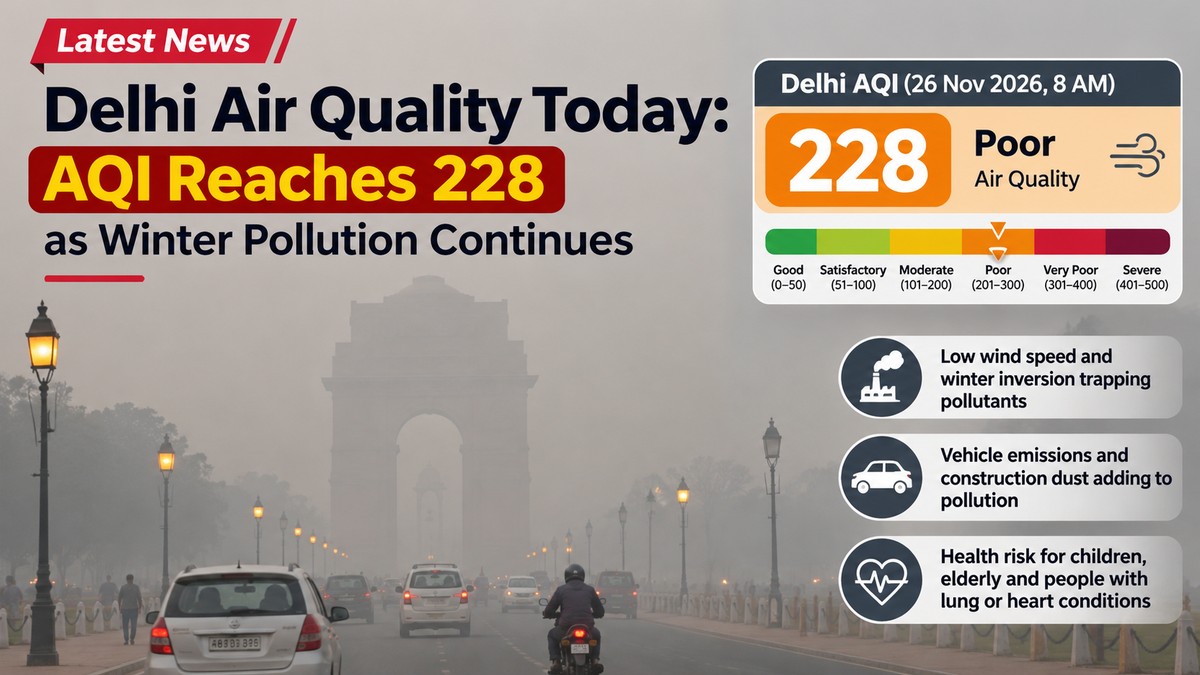
Delhi AQI reaches 228 on November 26, 2026. Explore the latest air quality updates, pollution causes, health risks and government measures.
Why is Delhi's air quality getting worse?
During winter, several environmental and human-related factors contribute to air pollution:
- Increasing vehicle emissions and traffic congestion.
- Industrial emissions and construction dust.
- Low wind speeds and temperature inversion.
- Burning of waste and agricultural residues.
- Accumulation of fine particulate matter, including PM2.5 and PM10.
Cold weather and weak winds make it difficult for pollutants to disperse, allowing them to remain concentrated near ground level.
Health effects of poor air quality
Exposure to polluted air can affect respiratory and cardiovascular health. Fine particles such as PM2.5 can penetrate deep into the lungs and enter the bloodstream.
Prolonged exposure may contribute to breathing difficulties, coughing, eye irritation, asthma complications and an increased risk of heart and lung diseases.
Children, elderly individuals and people with existing respiratory conditions are particularly vulnerable.
Government sets new pollution reduction target for 2027
The Commission for Air Quality Management (CAQM) has introduced a target to reduce annual average air pollution levels across Delhi-NCR by 15–20% in 2027 compared with 2026.
The initiative includes district-level action plans, improved industrial emission controls, dust management, vehicle pollution reduction and stronger monitoring measures.
GRAP Stage III restrictions were revoked on November 17, 2026, while Stage I and Stage II measures remained in force.
How to protect yourself from air pollution
Residents can reduce their exposure by checking local AQI readings regularly, limiting strenuous outdoor activities when pollution levels are high, wearing a well-fitting N95 mask outdoors and using effective indoor air filtration where possible.
Businesses and industries can also contribute by adopting air pollution control systems, conducting regular air quality monitoring and maintaining efficient dust and emission management practices.
Will Delhi's air quality improve?
Weather forecasts indicate that air quality could remain in the poor category on November 27 and 28, with atmospheric conditions continuing to restrict pollutant dispersion.
Long-term improvement will require effective environmental policies, cleaner transportation, industrial pollution control and greater public awareness.
Conclusion
The latest Delhi air quality update highlights the urgent need for sustainable pollution control solutions. Continuous air quality monitoring, cleaner technologies and collective efforts can help create a healthier environment for future generations.










0 Comments
No comments yet — be the first to share what you think.