
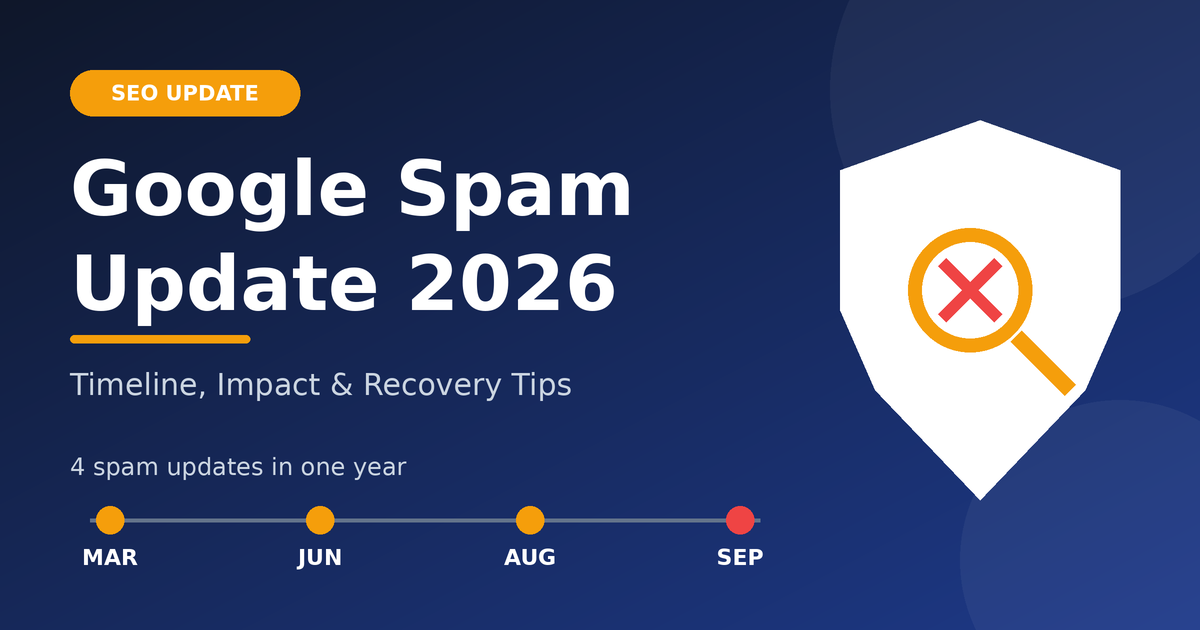
Google rolled out 4 spam updates in 2026. See the dates, what they target, how to check your traffic drop, and simple steps to protect your site.
Google Spam Update 2026: What Changed and How to Protect Your Website
Google has released four spam updates in 2026. If your traffic moved up or down this year, a spam update may be the reason. Here is what happened, what these updates do, and what you should do now.
What Is a Google Spam Update?
Google has automated systems that detect spam in search results. These systems run all the time, but sometimes Google makes a notable improvement to them, and that release is called a spam update. The goal is simple: push spammy pages down, or remove them from results.
A spam update is not the same as a core update. A core update looks at overall quality signals. A spam update focuses on sites that break Google's spam policies.
Google Spam Updates in 2026
Here is the timeline so far:
- March 2026: The first spam update of the year. It was the second announced Google update of 2026, and it finished in under 24 hours. That made it the fastest spam rollout on record.
- June 2026: It started on June 24 and finished on June 26, and it applied globally to all languages. Google said it did not target link spam or site reputation abuse.
- August 2026: It ran from August 18 to August 21, about 2 days and 16 hours. Google announced no new spam policies with it.
- September 2026: The fourth spam update of the year. It began on September 24 and completed on October 8. Some SEOs said its impact felt closer to a core update.
Right after these, Google started the November 2026 core update on November 10. It may take up to two weeks to complete. So if you see ranking changes this month, check which update caused them before you make changes.
What Do These Updates Target?
Google rarely says exactly what a spam update targets. For most of the 2026 updates, it gave no new rules. Your best guide is the existing spam policies. These are the common problems:
- Scaled, low-value content: Hundreds of pages made quickly, with no real help for the reader. This includes mass-produced AI content with no human review or original value.
- Keyword stuffing: Repeating keywords again and again so the page reads badly.
- Cloaking and sneaky redirects: Showing one thing to Google and another to users.
- Link schemes: Buying links or joining link networks.
- Expired domain abuse: Buying old domains just to host unrelated content.
- Site reputation abuse: Hosting low-quality third-party content on a trusted site to borrow its ranking power.
- Manipulating AI answers: In May, Google clarified that its spam policies also apply to attempts to manipulate generative AI responses, including AI Overviews and AI Mode.
How to Check If a Spam Update Hit Your Site
Do not panic and do not rewrite pages right away. Follow these steps:
- Match the dates. Open Google Search Console and look at the Performance report. Compare your traffic drop or rise with the rollout dates above.
- Check Manual Actions. A manual action is different from an algorithm update, and it shows in Search Console.
- Rule out other causes. Look for tracking errors, technical bugs, seasonal dips, or a core update running at the same time.
- Compare with competitors. Use a rank tracker to see whether similar sites moved too. Semrush also suggests lining up ranking shifts with the rollout dates and comparing against competitors.
How to Recover or Stay Safe
Google's advice is clear: sites that see a change after a spam update should review the spam policies. In practice, this means:
- Remove or improve thin pages. If a page has no real value, merge it, rewrite it, or delete it.
- Publish content with real expertise. Add original examples, real experience, and accurate facts. Review any AI-assisted content carefully before publishing.
- Clean your backlinks. Remove or disavow links you bought or built through schemes.
- Fix technical tricks. Remove hidden text, doorway pages, and sneaky redirects.
- Be patient. Recovery can take time. Google can refresh these systems later, and one source notes it can take many months to recover. Also, if the update was about link spam, making changes might not bring an improvement.
Final Thoughts
Spam updates in 2026 came faster and more often than before. The message from Google stays the same: write for people, follow the spam policies, and avoid shortcuts. Sites that build real value do not need to fear these updates. Sites that depend on tricks and mass-produced pages should expect more risk.









0 Comments
No comments yet — be the first to share what you think.